History
In 1965 Central Lanark Pastoral Charge was created consisting of three congregations: Guthrie, Trinity, and St Andrews United Churches. Members of Rosetta United Church joined either Guthrie or Trinity United Churches. St Andrews United Church closed in 2012, and the congregation joined Trinity.
Now operating as a two-point charge, Central Lanark has a rich heritage coming from its denominational roots in the Methodist, Congregational, and Presbyterian traditions, and from the unique characteristics brought by the congregations of Rosetta, Poland, Hood, and Watsons Corners.
Despite the many changes our churches have made to respond to local and organizational needs and realities, they have been a consistent part of our communities over the centuries.
Guthrie United Church – Clayton

The Clayton area described a thriving Methodist community beginning in 1825 and flourishing for almost a hundred years. A church building was erected in what is now known as the Old Methodist Cemetery near Clayton.
In 1840s local settlers erected a church building known as Union Hall which was used cooperatively by all local denominations. The local Presbyterians worshiped here until they built a church with a balcony in Clayton village in 1873. By 1897 they had outgrown this building so built the brick church across the road which is still used today. In 1919 they welcomed the local Methodist congregation. In 1925 became known as Guthrie United Church of Canada.
St John’s United Church – Hopetown
The first Hopetown Methodist Church was a log structure located towards the back of the Hopetown cemetery and was also used by the Presbyterians and Congregationalist congregations. In 1899, the St John’s Presbyterian church was built across the road. Services were held in the morning, afternoon, and evening.
In 1925 the Presbyterian and Methodist congregations voted to join the United Church of Canada. In 1962 a major expansion added a Christian Education Building to the back of the church. In 1965 Hopetown-Middleville Trinity Church was formed. In 1996 a washroom was added along with a wheelchair ramp through local donations. Sadly, in 2022 the Hopetown church was sold to a private owner.

Congregational (Stone) Church – Middleville, ON

Middleville Congregational Church was established in 1852 with 50 or 60 families from Lanark, Hopetown, Middleville, and Rosetta. In 1884 the Congregational stone church built. The Brass Bell tolled for worship, funerals, fire calls and New Years, along with ringing each day at 7am, noon, & 6 pm by Wm Croft. Even after Wm died his dog, Gyp, would howl at the correct times. In 1924, it formed a union with Middleville Presbyterian Church, and in 1925 became part of the United Church of Canada.
Middleville Presbyterian Church – Middleville, ON
The Presbyterian congregation originally held services in a log building across the road from the Fairgrounds and later at Young’s Schoolhouse (located where Ken Manson’s house is now). In 1823, an acre of property was obtained at the northwest corner of Main Street where Trinity United Church is located today. The property was for the Presbyterian Schoolhouse, Church, and burial grounds.
In 1873, Middleville villagers became worried of contaminated from the graves (many had died from diphtheria) and they were moved to a site north of the village to establish Greenwood Cemetery. 1892 a new Presbyterian brick church, known as St Paul’s, was built from stones from local farms. In 1925 when Presbyterian St. Paul joined the United Church of Canada the new name was Trinity United Church. The brass bell from the former Congregational Church in Middleville was moved to the Trinity Church belfry in 1999. In 2016 it was erected on the ground near the front step. In 2000 a working kitchen, washroom facilities, storage space and an office were built. The Church sanctuary pews have since been removed to form a multi-purpose space.


Rosetta United Church – Rosetta, ON
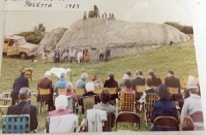

The Preaching Rock was used by the pioneers for the first open-air
services on land now owned by the James family. Folklore says early families walked barefoot as far as 26 miles to the rock to have their children baptized in the early 1800’s. The Rock was used many times when the Rosetta Churches were being rebuilt. Over the years many annual services have been held there with joint services of the surrounding Churches.
In 1885, the original Presbyterian Church was a log building on the corner of John Dick’s farm for the church and cemetery. In 1898, the current church as built on the same location with the cemetery grounds surrounding it. Unfortunately, it burned in 1919 and a new church was built the same year. The Church closed in 1965 and became part of Central Lanark Pastoral Charge.
St Andrew’s United Church – Watson’s Corners, ON
Worship services were held in private homes until 1828 when St Andrews’ Hall was built, serving as a library, a community Hall, township hall and a place of worship on the farm of Andrew Park which was north-west of Watson’s Corners. In 1894, the Zion Church was built in the village. A manse was built in 1893 and burned in 1911. In 1965, St James (Hood, ON) and Zion Churches joined and became part of Central Lanark Pastoral Charge and the Church was renamed St Andrews United Church. In 2012, St Andrew’s’ congregation amalgamated with Trinity United Church in Hopetown and Middleville.